Scent: Fresh and uplifting. Notes of Tiare flower and jasmine with soft magnolia petals, violet leaves, green bamboo, and palm fronds evoke the smell of the dewy tea fields of Indonesia at sunrise.
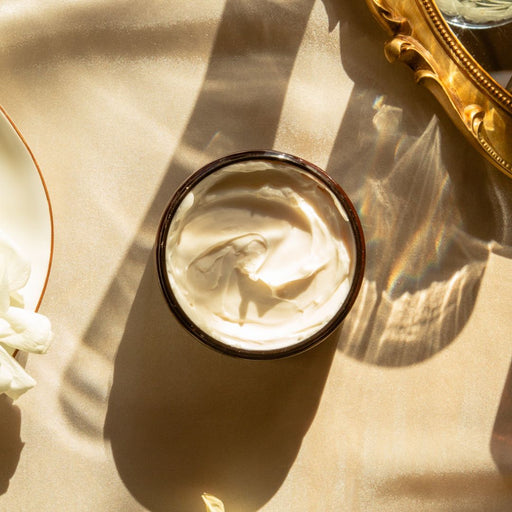
Texture: Buttery, whipped yet fast-absorbing
Color: Cream
Benefits & Features
Features essential fatty acids with omega-rich candlenut, avocado, and carrot seed oils with antioxidant vitamin E and indulgent Illipe butter. Antioxidant and anti-inflammatory ingredients help protect skin from environmental stress, sun damage, and dry climate.
Has a signature hydrating yet non-greasy feel, leaving skin feeling smooth and velvety.
Directions
This product can be used daily for maximum benefits.Warm the desired amount of product in the palm of your hand, letting it warm just slightly, and then massage creme gently into the skin until it is fully absorbed.
Apply generously on freshly cleansed skin or re-apply any time of day for a boost of moisture.
Ingredients
Candlenut Oil: Moisturizes and softens skin with a non-greasy, velvety feel. Rich in linoleic and linolenic acid, candlenut oil moisturizes and helps mend rough, chapped skin.Rice Bran Oil: Maintains elasticity. Rich in natural Vitamin E and essential fatty acids, rice bran oil intensely hydrate and help maintain youthful elasticity.Avocado Oil: Nourishes and calms. Traditionally used in Indonesia, Avocado Oil is richly hydrating and highly soothing.Illipe Butter: Moisturizes and protects. Provides a cushiony barrier to protect skin from dehydration, hard water and harsh elements.All Ingredients: Water/Eau, Cetearyl Ethylhexanoate, Emulsifying Wax NF, Cyclomethicone, Illipe (Shorea stenoptera) Seed Butter, Candlenut (Aleurites moluccana) Oil, Avocado (Persea gratissima) Oil, Stearyl Alcohol, Rice Bran (Oryza sativa) Oil, Dimethicone, Carrot (Daucus Carota sativa) Seed Oil, Potassium Hydroxide, Carbomer, Fragrance/Parfum, Phenoxyethanol, Caprylyl Glycol, Glycerin, Glyceryl Caprylate, Phenypropanol.
“Lorem ipsum dolor sit amet, consectetur adipiscing elit. Nulla quis diam lorem. Praesent auctor dapibus purus, eu facilisis nunc auctor et. In fermentum nunc et est vulputate malesuada.”
In today's world, free radicals are impossible to avoid, and they can damage the skin in many ways. We explain how and outline some simple steps you can take to protect your skin from free radical damage.
Key Takeaways
Free radicals are molecules with an extra, unpaired electron, which makes them highly unstable and reactive.
That unpaired electron allows free radicals to steal electrons from other molecules, a process that can cause damage.
High concentrations of free radicals can cause widespread damage in the body, including the skin.
Antioxidants are molecules known as "free radical scavengers" due to their ability to neutralize free radicals.
A diet rich in antioxidants can help protect the body from free radical damage.
Antioxidant-rich skincare products can also support the skin.
Metta Murdaya, co-founder of JUARA Skincare, says:
"Free radicals are unstable molecules that can damage cells. In the skin, free radicals can cause dryness, dullness, inflammation, dark spots, and premature skin aging. You can fight free radical damage with antioxidants, including in skincare products."
You've likely heard of free radicals. If not, then you've almost certainly heard of antioxidants, which are the counterpart to free radicals.
And if you've heard of neither, you're in the right place.
Free radicals are responsible for a type of damage called oxidative stress or oxidative damage. They can cause this damage in many parts of the body, including the skin.
To understand how they cause this damage, and how you can prevent it, we need to zoom in on the molecular level.
What Are Free Radicals?
Molecules are some of the smallest building blocks in our bodies. They're composed of two or more atoms joined together by bonds.¹
These chemical bonds are formed by the interactions between each atom's electrons. Normally, molecules have a set, stable number of electrons that stick together in pairs.²
Free radicals are a little different. Unlike many molecules, they have an unpaired electron. That makes them highly reactive and able to steal electrons from other molecules. ³
This process can be damaging to molecules and other structures. Free radicals can damage cells, proteins, and even DNA.
In small quantities, our bodies can handle free radicals. In fact, our bodies naturally produce free radicals.⁴
Free radicals can also come from various external sources. UV rays, environmental pollutants, and other external factors can all cause free radical formation in our bodies.
The problem arises when the concentration of free radicals increases beyond our body's ability to manage. As they accumulate to high concentrations, the damage they cause also accumulates.
How Free Radicals Affect Skin
The skin is particularly vulnerable to free radical damage. That's because it's often exposed to UV radiation, which can trigger free radical production.
Oxidative stress can undermine skin health in several different ways. Free radicals can damage cell membranes, including those in skin cells. They can undermine the functioning of the skin barrier. And they can degrade the collagen and elastin that help keep skin tight and smooth.
In many cases, there will be visible signs of free radical damage, including:
There are two key principles to protecting your skin from free radical damage.
The first principle is protecting your skin from free radicals in the first place. Fewer free radicals means reduced oxidative stress.
One easy way to do this is to limit sun exposure. Sunlight is crucial for overall wellness, but it's also a source of free radicals. Consider adding sunscreen to your morning skincare routine, even if it's grey out.
Completely avoiding free radicals is impossible. So the second principle is neutralizing free radicals that may form or accumulate in your skin.
The best way to reduce free radicals is with antioxidants. These helpful molecules are able to donate an electron to free radicals without being damaged or becoming reactive themselves.
Like with free radicals themselves, our bodies naturally produce antioxidants. But that isn't always enough to combat free radical damage.
Fortunately, we can support our body's natural antioxidant production with antioxidant-rich skincare products and foods.
There are all kinds of topical antioxidants. They can be roughly divided into two different types.
The first type is called direct antioxidants. These antioxidants directly neutralize free radicals. Examples include vitamin C, vitamin E, and beta-carotene.
The second type is called indirect antioxidants. These might not directly combat free radicals, but help support our body's ability to combat them and recover from the damage they cause.
Both types of antioxidants can be used in skincare products to support the skin.
Fortunately for us, plenty of plants are extremely rich in antioxidants.⁵ For example, research shows that many different kinds of teas are excellent sources of antioxidants.⁶
JUARA formulates its skincare products using botanical-based ingredients like tea to help protect against free radical damage.
For example, JUARA's Triple Tea Antioxidant Essence contains three types of tea, each rich in antioxidants. Similarly, JUARA's Face Creme for Menopausal Skin contains kombucha, a type of fermented black tea that is also rich in antioxidants.
JUARA's Sweet Black Tea and Rice Moisturizer blends kombucha with rice bran oil, which is rich in vitamin E, another powerful antioxidant. And JUARA's Radiance Complex Plumping Serum with Turmeric contains a unique blend of botanical ingredients high in vitamin C with antioxidant-rich goji berry to protect the skin from environmental stressors.
"The damage caused by free radicals is cumulative," explains dermatologist Dr. Arini Widodo in a conversation with JUARA co-founder Metta Murdaya. "So if we start to use the antioxidant as early as possible, we reduce free radical [accumulation] in our bodies.… So we should start early to prevent the damage."
Add Antioxidants to Your Diet
An antioxidant-rich diet is another great way to protect against free radical damage. Over the years, scientists have examined the antioxidant content of tens of thousands of different food ingredients to figure out which contain the most antioxidants.⁷
Fruits, vegetables, spices, nuts, dark chocolates, and drinks (including tea) are all great sources of antioxidants.⁸
According to the USDA, the 20 fruits and vegetables with the highest concentration of antioxidants are:⁹
Prunes
Raising
Blueberries
Blackberries
Kale
Strawberries
Spinach
Raspberries
Brussels sprouts
Plums
Alfalfa sprouts
Broccoli florets
Beets
Oranges
Red Grapes
Red bell peppers
Cherries
Onions
Corn
Eggplant
These are far from your only options. Cocoa is rich in antioxidants. So are nuts like pecans and walnuts.¹⁰
Seafood, sweet potatoes, lentils, red wine, whole grains, and spices like turmeric, ginger, and cinnamon are all good sources of antioxidants, too.¹¹
Conclusion
Free radicals are unstable molecules that can cause all kinds of damage to the skin, from cell death to premature skin aging and beyond. Fortunately, we can protect our skin from this damage by reducing exposure to free radicals and using antioxidants.
Antioxidants are rich in nature. You can get them through foods and in botanical-based skincare products. JUARA selects ingredients based on both clinical guidance and botanical research to help protect your skin from free radical damage.
Many factors can cause free radical production in the skin. Your body's natural metabolic processes produce free radicals, for example.
UV light is another common source of free radicals in the skin. So is pollution.
What Are Examples of Free Radicals?
One example of a free radical is the superoxide radical. It's a reactive oxygen species formed when a pair of oxygen atoms gains an extra electron, making them unstable. Superoxide radicals are sometimes created in the body.¹²
UV light can also trigger the formation of superoxide radicals. It can also cause the formation of hydroxyl radicals, one of the most reactive of all free radicals. Hydroxyl radicals can cause DNA damage, as well as damage to fats and proteins in the body.¹³
What Kills Free Radicals in the Body?
Free radicals aren't alive and therefore can't technically be "killed." But various molecules can eliminate or neutralize them.
The most common are collectively called antioxidants. These powerful molecules can neutralize free radicals and even help the body recover from oxidative stress caused by free radicals.¹⁴
Juara Skincare incorporates ancient rituals with Western skincare science, creating the ultimate beauty experience. We aim to transport you from the mundane to the extraordinary with our exotic ingredients, intoxicating scents, and powerful, skin-improving formulas. All of our products are nutrient-rich and botanically based. We are proud to be certified cruelty-free. Get the latest skin care tips and info on Juara products by learning more about our founders and following us on Twitter, Facebook, Instagram, LinkedIn, and Pinterest.
Metta Murdaya
Co-founder and CEO
Metta Murdaya is co-founder and CEO of JUARA Skincare, a skincare and beauty company inspired by the Indonesian wellness traditions of Jamu. Her award-winning book, Jamu Lifestyle, captures the essence of the Jamu philosophy, emphasizing the power of healthy, intentional, and joyful living. Guided by a deep commitment to societal betterment, Metta inspires individuals to thrive in mind, body, and spirit. As a wellness speaker and retreat guide, she contributes to the Global Wellness Institute’s Aesthetic Health Initiative and serves on the board of Mentari, supporting trafficking prevention and education initiatives in Indonesia and wellness programs in the U.S.