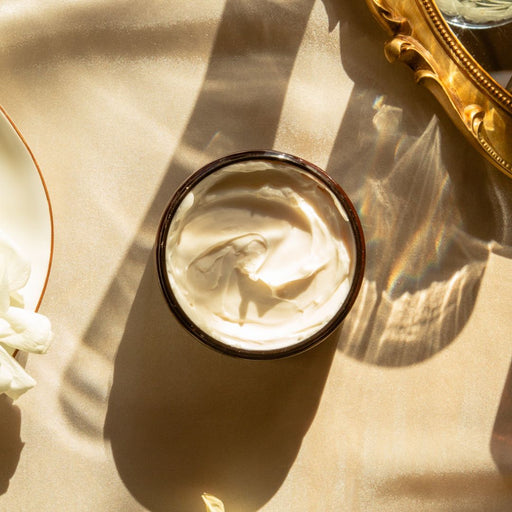
Scent: Fresh and uplifting. Notes of Tiare flower and jasmine with soft magnolia petals, violet leaves, green bamboo, and palm fronds evoke the smell of the dewy tea fields of Indonesia at sunrise.
Texture: Buttery, whipped yet fast-absorbing
Color: Cream
Benefits & Features
Features essential fatty acids with omega-rich candlenut, avocado, and carrot seed oils with antioxidant vitamin E and indulgent Illipe butter. Antioxidant and anti-inflammatory ingredients help protect skin from environmental stress, sun damage, and dry climate.
Has a signature hydrating yet non-greasy feel, leaving skin feeling smooth and velvety.
Directions
This product can be used daily for maximum benefits.Warm the desired amount of product in the palm of your hand, letting it warm just slightly, and then massage creme gently into the skin until it is fully absorbed.
Apply generously on freshly cleansed skin or re-apply any time of day for a boost of moisture.
Ingredients
Candlenut Oil: Moisturizes and softens skin with a non-greasy, velvety feel. Rich in linoleic and linolenic acid, candlenut oil moisturizes and helps mend rough, chapped skin.Rice Bran Oil: Maintains elasticity. Rich in natural Vitamin E and essential fatty acids, rice bran oil intensely hydrate and help maintain youthful elasticity.Avocado Oil: Nourishes and calms. Traditionally used in Indonesia, Avocado Oil is richly hydrating and highly soothing.Illipe Butter: Moisturizes and protects. Provides a cushiony barrier to protect skin from dehydration, hard water and harsh elements.All Ingredients: Water/Eau, Cetearyl Ethylhexanoate, Emulsifying Wax NF, Cyclomethicone, Illipe (Shorea stenoptera) Seed Butter, Candlenut (Aleurites moluccana) Oil, Avocado (Persea gratissima) Oil, Stearyl Alcohol, Rice Bran (Oryza sativa) Oil, Dimethicone, Carrot (Daucus Carota sativa) Seed Oil, Potassium Hydroxide, Carbomer, Fragrance/Parfum, Phenoxyethanol, Caprylyl Glycol, Glycerin, Glyceryl Caprylate, Phenypropanol.
“Lorem ipsum dolor sit amet, consectetur adipiscing elit. Nulla quis diam lorem. Praesent auctor dapibus purus, eu facilisis nunc auctor et. In fermentum nunc et est vulputate malesuada.”
If you're trying to decide what skincare products to buy, chances are you've seen the phrase "dermatologist-tested." Understanding what it actually means is vital if you want to pick the perfect product.
We break down the meaning of the term and similar terms to help you perfect your skincare routine.
Key Takeaways
The label "dermatologist-tested" means a product has been tested by at least one dermatologist.
It's not a regulated term, so there's no standard definition outlining what that testing must involve.
One common test used is known as the Human Repeat Insult Patch Test.
It's important to look at other aspects of a product, including its ingredient list and the experiences of people who've actually used it.
Making Informed Choices With New Skincare Products
Metta Murdaya, co-founder of JUARA Skincare, says:
"The dermatologist-tested label helps you differentiate between products that have been tested and those that haven't. That's helpful, but should only be one method you use to choose the perfect product for you."
Browse through the skincare aisle, and you'll come across the same phrase time and time again: "Dermatologist tested."
It sounds great. But what exactly does it mean?
And, more importantly, how much importance should you place on products having that label?
Basically, dermatologist-tested means the product in question has been tested. Specifically, it means the product's safety has been evaluated by one or more dermatologists.
You can probably see why having experts look at a product before it goes to market would be helpful. Dermatologists can help confirm whether a product is safe to use or not.
They have knowledge of specific skin concerns, like allergic reactions. If a product might cause adverse reactions or contain potential allergens, they should catch that. And they should have knowledge about what contributes to optimal skin health.
In short, then, the label is a green flag to look out for when choosing a product.
However, it's not quite as simple as it might seem. For one thing, there are plenty of variations on the term.
To help you choose the perfect products for your skin type, let us break it all down.
What Does "Dermatologist-Tested" Mean?
There's one important caveat to understand. The phrase "dermatologist tested" isn't regulated.
That means there's no official definition. At least, in the US, the FDA does not set a specific standard definition.
What does that mean? Well, it means the level of testing can vary.
A product labeled "dermatologist tested" has undergone some form of clinical evaluation by at least one dermatologist. But some might undergo extensive clinical trials, while others may undergo less rigorous testing.
Of course, any testing is better than none. That's why the label is helpful. It differentiates between products that haven't been tested at all, and those that have.
Patch Tests
One of the most common safety testing methods is called a Human Repeat Insult Patch Test, or HRIPT.
If you've ever tried a new product, chances are you've patch tested. It involves placing a little bit of the product on a small patch of skin, like on your arm. You wait and see how your skin reacts to the product before using it more.
The HRIPT is quite extensive. It can take six weeks to complete, and aims to mimic the effects of using a product frequently, as you would if that product was part of your skincare routine.
First, researchers apply the patches of the product to a single spot on a volunteer's skin. The product is usually left for a certain period, then removed, and the process repeated.
After a few weeks, the process is stopped. Researchers wait a couple of weeks, then apply the patches again to a fresh area of skin.
Throughout the process, researchers measure specific concerns, including potential irritation and other reactions. The reason it takes so long is that researchers have to wait to see if the volunteer's immune system will react to the product, as it would in the case of an allergic reaction.
All being well, the skincare product being tested won't trigger anything major.
The Importance of Using Dermatologist-Tested Products
Picking the right skincare products can be tricky. Everyone's skin is different, with different skin types and unique skin needs. You want an effective product that will suit your skin's unique needs.
Labels like "dermatologist-tested" are a good way to narrow down your options.
When you choose a dermatologist-tested product, you know it has been tested for safety. That kind of evaluation can be quite meaningful, especially in situations where products don't have to be approved by regulatory bodies before being sold.
It's also helpful when deciding between lots of different options. You can quickly rule out products that haven't been tested.
Sensitive Skin
Ensuring a product has been tested is particularly important for people with sensitive skin.
When skin is sensitive, it's naturally more reactive. It's a common skin type, like oily skin. That means it's more prone to becoming irritated when you apply a new product.
Ideally, a product that has been dermatologist-tested will be less likely to trigger potential reactions. That's generally a better starting point than a product that hasn't been tested at all.
However, it's always a good idea to double-check before committing to a new product, especially if you have particularly sensitive skin.
For example, you could look through the ingredient list. Are the ingredients natural? Do they include harsh, synthetic compounds?
You can also conduct your own patch test. Make sure to use a small area of skin, out of sight, like your inner forearm. Apply a small amount and wait a day or two, carefully watching for any signs of irritation.
The Difference Between Dermatologist-Tested and...
As we mentioned, dermatologist-tested is just one of many similar-sounding terms that you'll likely come across when searching for skincare.
Let's quickly go through some of the more common variants.
... Dermatologist-Approved
Dermatologist-approved has a slightly different meaning than dermatologist-tested. While dermatologist-tested means testing has occurred, dermatologist-approved often means a board-certified dermatologist has endorsed the product.
That goes beyond safety and hints at the actual effectiveness of a product. However, a product that is dermatologist approved might not necessarily have gone through the same testing process as a product that is dermatologist tested.
...Dermatologist-Recommended
Dermatologist-recommended is very similar to dermatologist-approved. Again, it means at least one dermatologist recommends the product.
But that recommendation isn't necessarily because the product has been tested for safety. It could mean the dermatologist likes the ingredients or the brand.
... Dermatologically-Tested
This is basically the same as the term "dermatologist tested." The phrasing is just a little different.
Where to Get High-Quality Dermatologist-Tested Products
Ultimately, labels are just one thing to look for when choosing a new skincare product.
They're a great place to start, and can help you rule out options that haven't been tested at all. But you should also consider products holistically, looking at the ingredients they use and testimonials from actual people who've used them.
For example, all of JUARA's products are dermatologist-tested. But they're much more than that.
JUARA's products are also 100% plant-based. Our formulas are carefully designed to nourish skin without irritation.
They're also inspired by Jamu, a centuries-old Indonesian wellness tradition. Our products are intended to support not just skin but overall wellness, too.
For example, take JUARA's Radiance Enzyme Scrub. It's plant-based and dermatologist-tested. Natural bamboo and jojoba beads gently polish skin, apple fruit enzymes visibly improve skin tone, and a proprietary blend of botanical actives promotes a brighter complexion.
"It has a gentle cleanser, so you can use this instead of your cleanser," explains JUARA co-founder Metta Murdaya. "I love the jojoba beads, because they leave a nice gentle feeling.… And it has apple enzymes also, which is a very gentle acid."
After just one use of this scrub, 99% of people felt it helped prep their skin for absorption of other skincare. 95% said it deeply cleaned without feeling harsh. 91% said their skin felt healthy-looking and invigorated.
And after four weeks of use, 95% said their skin felt and looked refined, soft, smooth, and supple.
Conclusion
Dermatologist-tested products are those that have been tested for safety with at least one dermatologist. The label is a great way to differentiate between products that have been tested and those that haven't.
But that's just one aspect of skincare products. It's generally a good idea to look at them holistically, considering things like their ingredients, the ethos of the brand, and the experiences of people who've used them.
Frequently Asked Questions
What Does It Mean When a Product Says Dermatologist-Tested?
The label means a product has been tested for safety and evaluated by a dermatologist.
Is a Dermatologist-Tested Product Good?
If a product is dermatologist-tested, that means it was tested with a dermatologist. That doesn't necessarily mean the product will be good, which is why it's important to look at other things, like the ingredient list, too.
What Not to Say to a Dermatologist?
When seeing a dermatologist, it's vital you be completely honest. Don't hide something out of embarrassment. Your dermatologist is there to help you, and they need accurate information to do so.
Juara Skincare incorporates ancient rituals with Western skincare science, creating the ultimate beauty experience. We aim to transport you from the mundane to the extraordinary with our exotic ingredients, intoxicating scents, and powerful, skin-improving formulas. All of our products are nutrient-rich and botanically based. We are proud to be certified cruelty-free. Get the latest skin care tips and info on Juara products by learning more about our founders and following us on Twitter, Facebook, Instagram, LinkedIn, and Pinterest.
Metta Murdaya
Co-founder and CEO
Metta Murdaya is co-founder and CEO of JUARA Skincare, a skincare and beauty company inspired by the Indonesian wellness traditions of Jamu. Her award-winning book, Jamu Lifestyle, captures the essence of the Jamu philosophy, emphasizing the power of healthy, intentional, and joyful living. Guided by a deep commitment to societal betterment, Metta inspires individuals to thrive in mind, body, and spirit. As a wellness speaker and retreat guide, she contributes to the Global Wellness Institute’s Aesthetic Health Initiative and serves on the board of Mentari, supporting trafficking prevention and education initiatives in Indonesia and wellness programs in the U.S.